Click once, get a live webhook URL and email address, curl it, watch it arrive. emithook.com → try → curl → delivered
Events are harder than they seem.
Email is worse.
Lost events, silent failures, nothing to replay when a customer asks “where’s my order?” — and when the same order arrives as an email, your webhook tooling can’t even see it. Today that’s three vendors and glue code.
catches your webhooks — but knows nothing about the emails carrying the same business events.
POSTs the mail once and shrugs — no retries, no replay, no delivery guarantees, no log to debug from.
pushes your events out — on yet another dashboard, signature scheme and retry policy to learn.
Emithook is all three on one engine — one log, one replay, one retry policy, one place to look when something breaks.
Receive webhooks. Receive email.
Send anywhere.
However an event reaches you — or leaves you — it rides the same pipeline: stored, verified, routed, retried, logged, replayable.
Webhooks in
Give providers a stable URL — we ack in <100ms and route to your systems. Be down for hours, lose nothing.
- HTTPS edge or a queue you already write to
- Provider presets: signature verify + handshakes
- Zero-setup domain, or bring your own
- Durable buffer, full audit, one-click replay
Email in
Give anything an email address. Incoming mail becomes a normal event — same delivery, retries and logs as a webhook.
- Unlimited addresses on your domain or ours
- SPF / DKIM / DMARC verdicts on every message
- Attachments ride as claim-check links
- An inbox your AI agent can read over MCP
Delivery out
Push your own events as webhooks-as-a-service — to a URL, a queue, or every subscriber of an application.
- Send API + per-tenant fan-out
- Standard Webhooks signing receivers trust
- Backoff retries, circuit breaker, dead-letter
- Consumer portal & delivery logs
Three delivery patterns, zero infra
One event → many destinations
An event always goes to the same set of endpoints. Define the routes once.
Same event → each tenant's URL
Register customers as applications. POST /v1/app/{tenant}/event resolves their destinations.
Just deliver this payload
Ad-hoc POST /v1/send to a URL or queue — we handle slow endpoints, retries and DLQ.
Config can never drop a webhook.
Neither can we.
Ingest is architecturally separate from everything else: every request is written to a durable queue before the sender gets its 200. Processing, delivery, your configuration — even our own deploys — happen after that, and none of them can lose what's already stored. Miss nothing; replay anything, for 14 days.
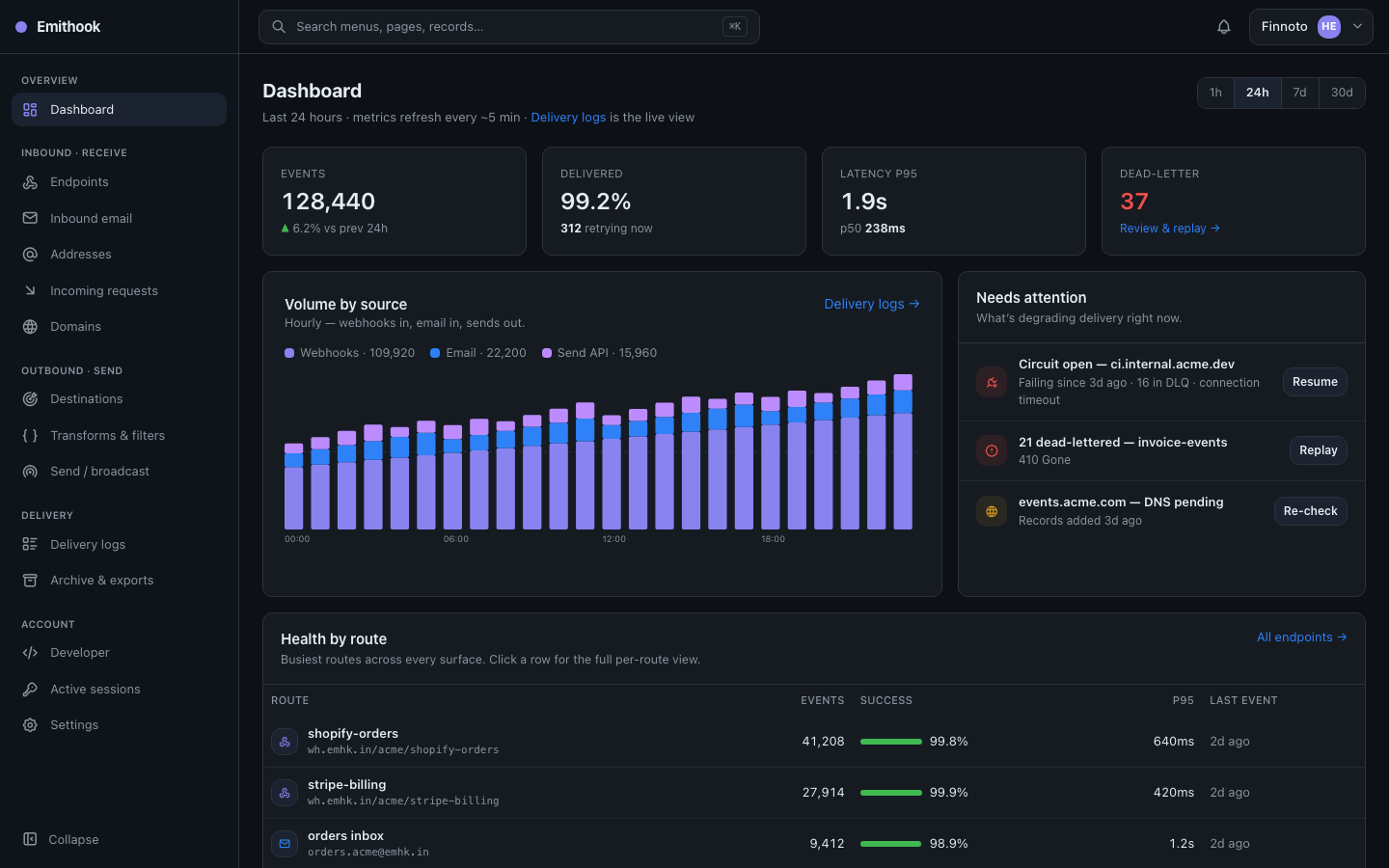
Simple enough for your PM.
A swiss-knife for you.
Every other tool in this category assumes a developer is driving. Emithook's console is simple by default — and one Advanced toggle away from the full toolkit.
Simple, by default
Three answers and you're live — no webhook expertise required.
- Who sends to this URL? Pick the provider — verification and handshakes arm themselves
- Paste the signing secret — we know each provider's headers and algorithms
- Pick a destination — retries, backoff and logs are automatic
Advanced, one toggle away
Flip the switch and the whole engine is yours.
- Custom responses, provider handshakes & sync proxy mode
- JS transforms (sandboxed) or your own HTTP transformer
- Generic HMAC, replay tolerance, zero-downtime secret rotation
- Per-route filters and the full retry schedule
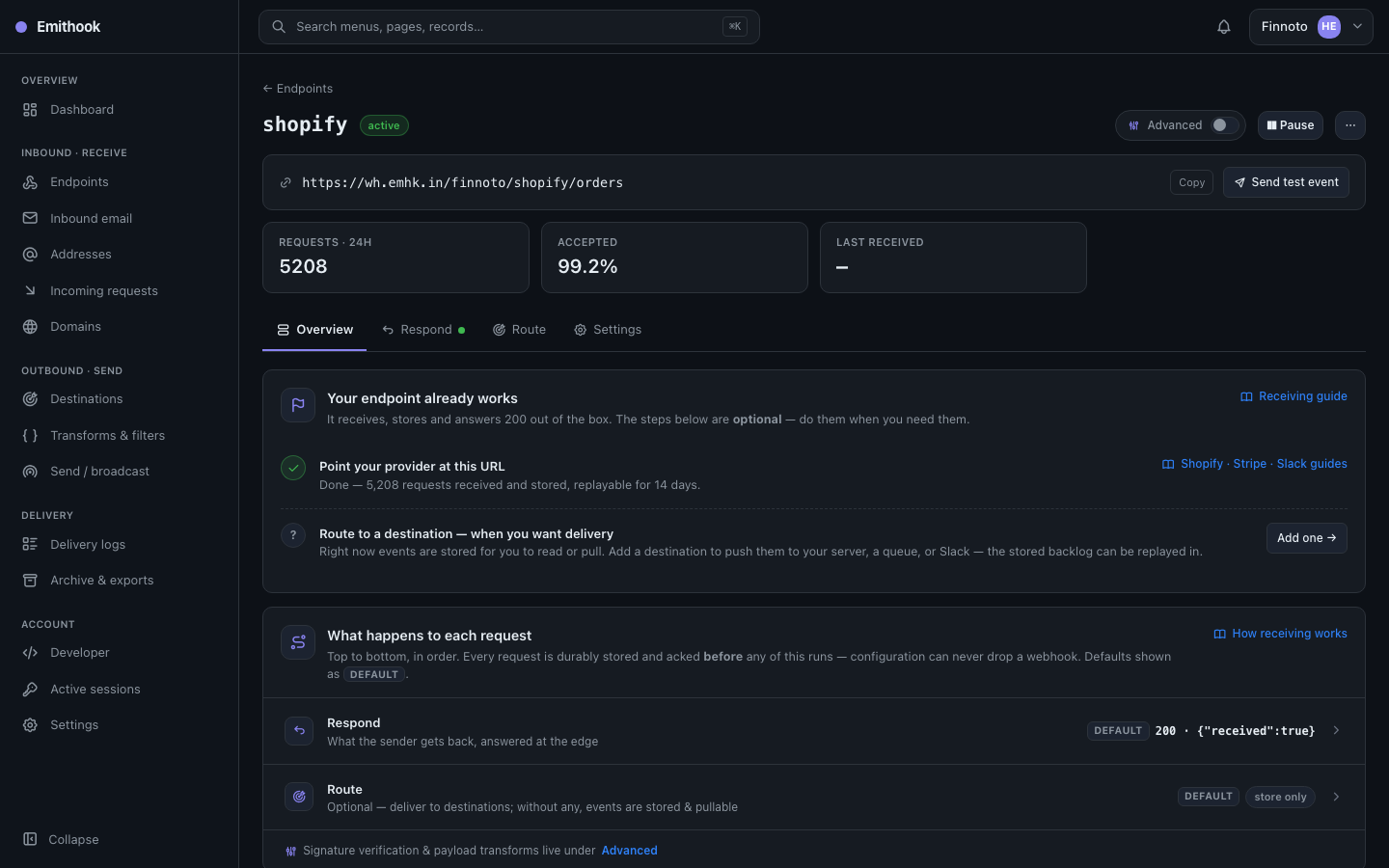
Everything reliable delivery needs
The reliability layer you'd otherwise build and maintain yourself.
Retries, DLQ & replay
Exponential backoff with jitter (immediate → 5s → … → ~28h), then a replayable dead-letter queue. Replay one, in bulk, or from the archive.
Signed payloads
Standard Webhooks HMAC with zero-downtime secret rotation.
SSRF-guarded
DNS-pinned, private-IP denylist, no redirects, isolated egress.
Circuit breaker
Auto-pause dead endpoints, park events, probe & recover.
Guided destinations & central registry
Define a destination once, reference it everywhere. Connect any queue via a step-by-step flow that hands you the exact IAM grant — no shared keys.
Zero-setup domains
Live instantly on our domain — bring your own with auto-TLS.
Logs & archive
Every attempt logged; gzipped hourly files per URL for export.
For your terminal, your code,
and your AI agents
Everything is one scoped API. The console, CLI, SDKs and an MCP server all do the same things — so an LLM can query deliveries and run ops, safely.
MCP server
Connect Claude, Cursor or your own agent. Reads are safe by default; writes (replay, rotate secret) need a write key & confirmation.
Full CLI
Operate & query from the terminal or CI — logs, replay, send, DLQ redrive. Scriptable, JSON output.
TypeScript SDK
One typed client for send + management today; more languages on the roadmap — or generate a client from the OpenAPI spec. Receivers verify with the open Standard-Webhooks libraries.
// deliver one payload to a destination
await fetch("https://api.emithook.com/v1/send", {
  method: "POST",
  headers: { Authorization: `Bearer ${EK_KEY}`,
             "Idempotency-Key": invoiceId },
  body: JSON.stringify({
    destination: "dst_acme",
    event_type:  "invoice.created",
    payload:     { amount: 4999, currency: "INR" }
  })
});  // → 202 { message_id }
// fan out to a tenant's subscribed endpoints
await emithook.app("acme").send({
  event_type: "invoice.created",
  payload: { id: "INV-2026-001", amount: 4999 }
});
// → delivered to every endpoint on invoice.*
//   each signed, retried & logged independently
// receivers verify with the open Standard Webhooks lib
import { Webhook } from "standardwebhooks";

const wh = new Webhook(process.env.WHSEC);
app.post("/hooks", (req, res) => {
  const evt = wh.verify(req.rawBody, req.headers); // throws if invalid
  handle(evt);
  res.sendStatus(200);
});
# operate & query from your terminal
npm i -g @emithook/cli
emithook replay --dlq --endpoint /razorpay-live
emithook send -d dst_acme -t invoice.created -f body.json
# same scoped API powers console, CLI & MCP
Standard Webhooks compliant, on the wire
Every payload we sign verifies with the open standardwebhooks libraries — no proprietary SDK required to receive from us, ever. Open contracts over lock-in.
Questions, answered
What is Emithook?
Does it handle both inbound and outbound?
Can I try it without an account?
Is it LLM / AI-agent friendly?
Can it turn inbound email into webhooks — and can an AI read it?
How fast can I start — do I need DNS?
Where is my data stored?
Give every event a front door.
Your instant endpoint is one click away — a webhook URL and an email address, live right now, no signup.